
Which communities of Goan voters, and how many, and what percentage, have been deleted from the electoral roll of Goa’s 40 Assembly constituencies during the Special Intensive Revision (SIR) by the Election Commission of India?
Also, what is the proportion of male and female voters, what are their ages, and what reasons are cited for deletion?
By digging into over 1700 booth-wise electoral rolls from Goa’s final Special Intensive Revision (SIR) roll, goanews.com has managed to decode the roll near-perfectly, with the help of young techies.
CLICK FOR BETTER READABILITY IN PDF
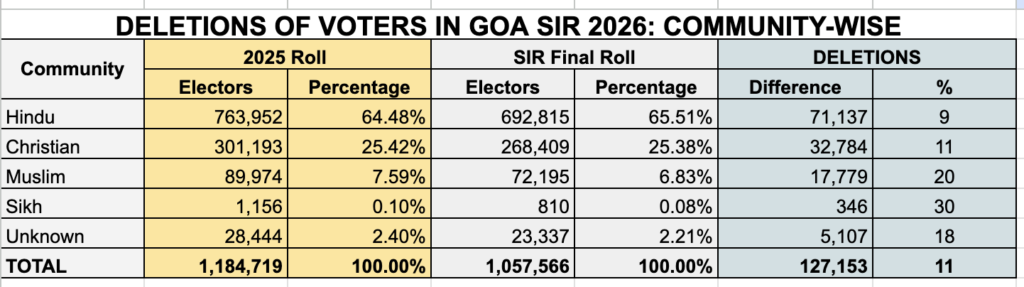
The Chief Electoral Officer of Goa has already said total deletions have been around 11 per cent, or a little over 1.27 lakh voters. As a result, the number of voters has been reduced from 11.85 lakh (2025 roll) to 10.58 lakh (SIR Final 2026).
Interestingly, the percentage of voters community-wise, especially the Hindus, the Christians and the Muslims, remains nearly the same, with little variation upwards or downwards. However, decoding it further reveals that the largest number of deletions has taken place among the Muslim community – around 20 per cent, followed by 11 per cent among Christians and 9 per cent among Hindus.
The net deletions of voters have been counted after subtracting the number of new voters added during the SIR exercise. The additions are only 12,166 voters. It is hardly 1.15% of 10.58 lakh voters.
In terms of voter numbers, around 71,000 of the 7.64 lakh Hindu voters have been deleted. However, because Hindus make up around 65 per cent of the total electorate, this deletion amounts to nine per cent within the community.
From around 3 lakh Christian voters, around 33,000 names have been deleted. With a 25 per cent share of the Goan electorate, this is 11 per cent.
CLICK FOR BETTER READABILITY IN PDF
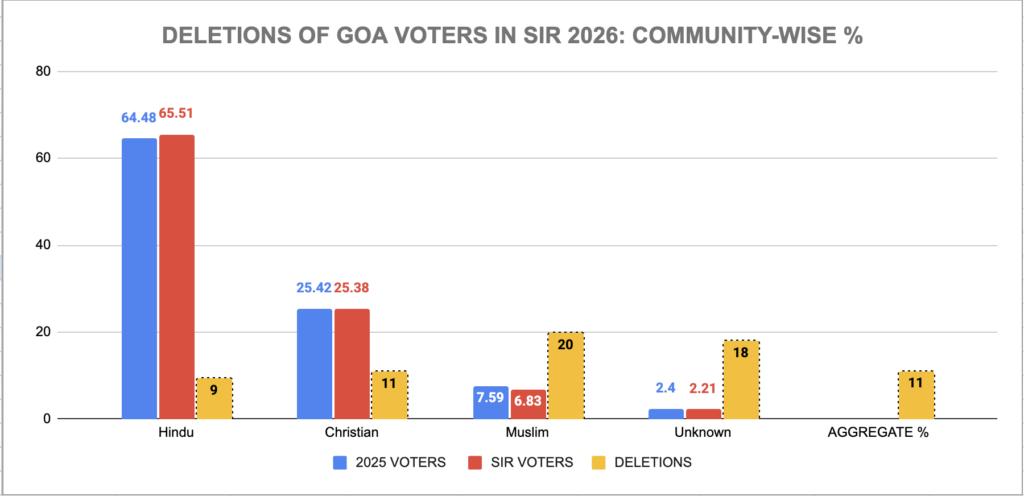
The Muslim community ranks third in Goa, with around 90,000 voters. Around 18,000 names from this community have been deleted, meaning around 20 per cent.
The dig-up also found a Sikh community in Goa, but with fewer than 1,200 voters. This number has been reduced to 810, with around 350 deletions, or 30 per cent.
Since the Election Commission of India does not register the religion of the voter, their religion has been identified on the basis of their names, father’s names and surnames. However, where ambiguity prevents a definite conclusion, these voters have been categorised as “Unknown” in terms of religion.
Around 5000 such names have been identified and categorised as “Unknown”. They make up four per cent of all deletions, though the deletion rate within the group is 18 per cent.
GOA JOINS THE NATIONAL STREAM?
Nationwide, there is an uproar over the deletion of crores of voters. Many political leaders have alleged that minorities have been targeted during the deletion exercise. Asaduddin Owaisi, leader of the All India Majlis-e-Ittehadul Muslimeen, was one of the national leaders who listed minority deletions in various states across the country.
In West Bengal, almost 34% of Muslim voters were deleted, even though the minority community comprises 27% of the state, as reported by The Hindu, a leading national daily.
Also, in Goa, it was alleged by Goa Forward spokesperson Prashant Naik in January this year that existing voters in his Canacona Assembly constituency have been deleted, especially Christians.
MORE DELETIONS IN OLD CONQUESTS
In view of this, goanews.com also decoded data from all 40 Assembly constituencies to identify voter deletions across religions.
The deletion exercise ranged from 3 per cent to 30 per cent. The lowest was 955 deleted voters in Mandrem (2.86%), and the highest was 11,657 voters in Vasco (32%).
A large number of deletions also occurred in the constituencies of Old Conquests: 20% to 30% in five constituencies, 14% to 16% in seven constituencies, and 10% to 13% in seven constituencies. Only five from among the total 24 constituencies of the Old Conquests – Siolim, Velim, Nuvem, Cuncolim and Benaulim – fall in the category of 6% to 8% deletions.
Comparatively, Ponda is the only constituency in the New Conquests that falls in the 10% to 13% deletion category. Of the remaining 15 constituencies, five fall in the 6% to 8% category, and 10 constituencies fall in the lowest category of 4% to 5% deletions.
Only two constituencies show the highest number of Hindu deletions compared with other religions: Navelim (14%) and Velim (8%).
In contrast, Christian deletions exceed those of other religions in 11 constituencies. Muslims supersede all other religions in almost 27 constituencies.
Only three constituencies show equal percentages of deletions of Christians and Muslims. Mapusa (17%), Valpoi (11%) and Shiroda (10%).
CLICK TO READ DETAILED TABLE IN PDF
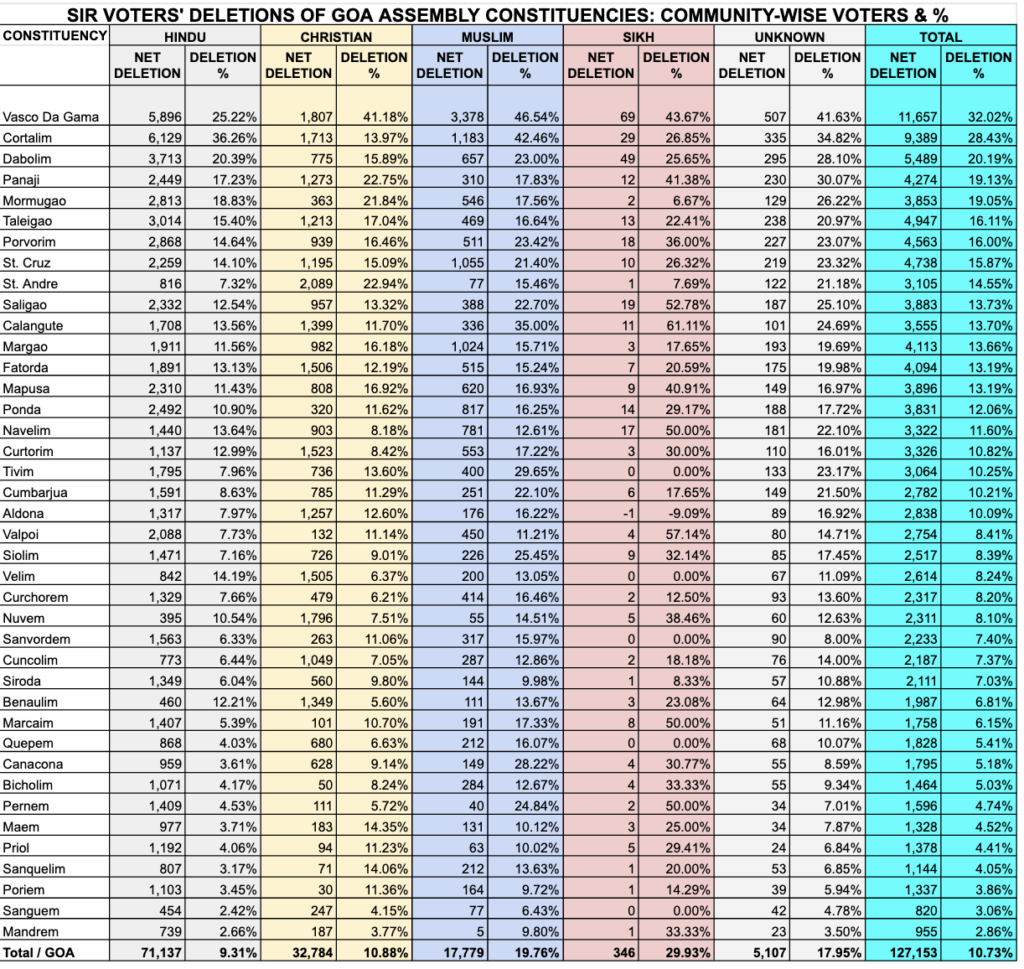
The net deletions, after subtracting new voters added to the SIR Final electoral roll, are as follows:
DELETION BETWEEN 15-30%
- Voters between around 3900 and 12,000 have been deleted in five Assembly constituencies.
- MORMUGAO: Vasco: 32%, Cortalim: 28%, Dabolim: 20% and Mormugao: 19%.
- TISWADI: Panaji: 19%.
- Higher Muslim deletion percentages: Vasco, Cortalim, and Dabolim.
- Higher Christian deletion percentages: Mormugao and Panaji.
DELETION BETWEEN 14-16%
- Voters between 4000 and 5000 have been deleted in seven constituencies.
- BARDEZ: Porvorim: 16%, Saligao: 14%, Calangute: 14%.
- TISWADI: Taleigao: 16%, St. Cruz: 16%, St. Andre: 15%.
- SALCETE: Margao: 14%.
- Higher Muslim deletion percentages: Porvorim, St. Cruz, Saligao, and Calangute.
- Higher Christian deletion percentages: Taleigao, St. Andre, Margao.
DELETION BETWEEN 10-13%
- Voters between 2900 and 4000 have been deleted in eight constituencies.
- BARDEZ: Mapusa: 13%, Tivim: 10%, Aldona: 10%.
- SALCETE: Fatorda: 13%, Navelim: 12%, Curtorim: 11%.
- TISWADI: Cumbarjua: 10%.
- PONDA: Ponda: 12%.
- Higher Muslim deletion percentages: Fatorda, Mapusa, Tivim, Aldona, Ponda, and Curtorim.
- Higher Christian deletion percentages: Mapusa.
- Higher Hindu deletion percentages: Navelim.
DELETION BETWEEN 6-8%
- Voters between 1800 and 2800 have been deleted in 10 constituencies.
- SALCETE: Velim: 8%, Nuvem: 8%, Cuncolim: 7%, Benaulim: 7%.
- PONDA: Shiroda: 7%, Marcaim: 6%.
- BARDEZ: Siolim: 8%.
- QUEPEM: Curchorem: 8%.
- DHARBANDORA: Sanvordem: 7%.
- SATTARI: Valpoi: 8%.
- Higher Muslim deletion percentages: Valpoi, Siolim, Curchorem, Nuvem, Sanvordem, Cuncolim, Shiroda, Benaulim, Marcaim.
- Higher Christian deletion percentages: Valpoi, Shiroda.
- Higher Hindu deletion percentages: Velim.
DELETION BETWEEN 4-5%
- Voters between 955 and 1800 have been deleted in 10 constituencies.
- BICHOLIM: Bicholim: 5%, Maem: 5%, Sanquelim: 4%.
- PERNEM: Pernem: 5%, Mandrem: 3%.
- QUEPEM: Quepem: 5%.
- CANACONA: Canacona: 5%.
- SATTARI: Poriem: 4%.
- PONDA: Priol: 4%.
- SANGUEM: Sanguem: 3%,.
- Higher Muslim deletion percentages: Quepem, Canacona, Bicholim, Pernem, Sanguem, Mandrem.
- Higher Christian deletion percentages: Maem, Priol, Sanquelim, Poriem.
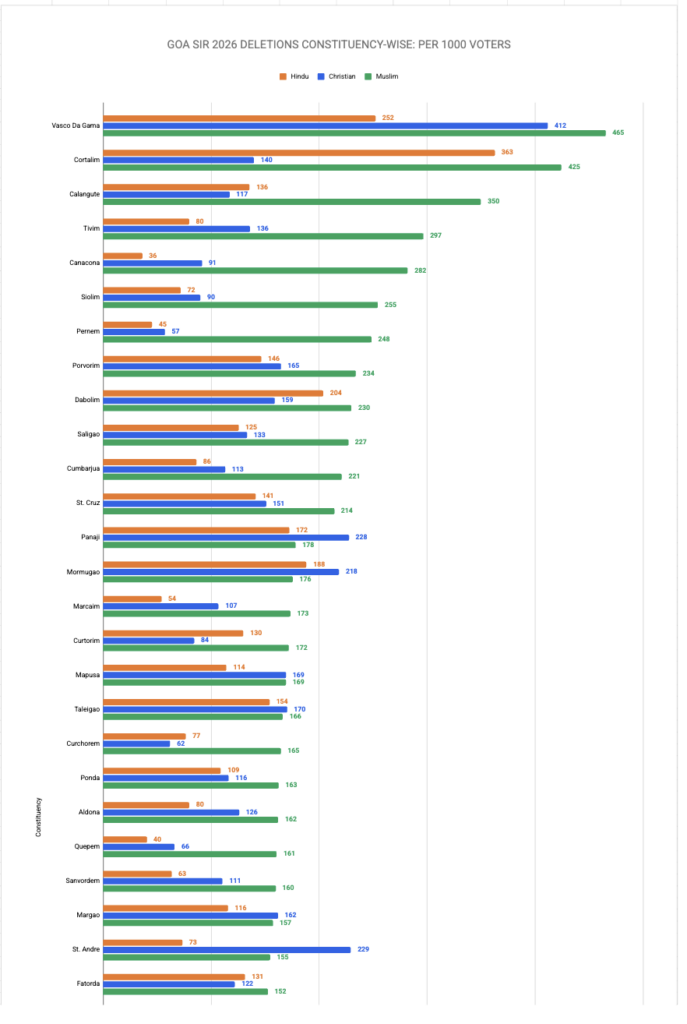
For cross-verification, we also measured religion-wise deletions per 1000 voters. The graph says it all.
CLICK FOR BETTER READABILITY IN PDF
HINDU DELETIONS


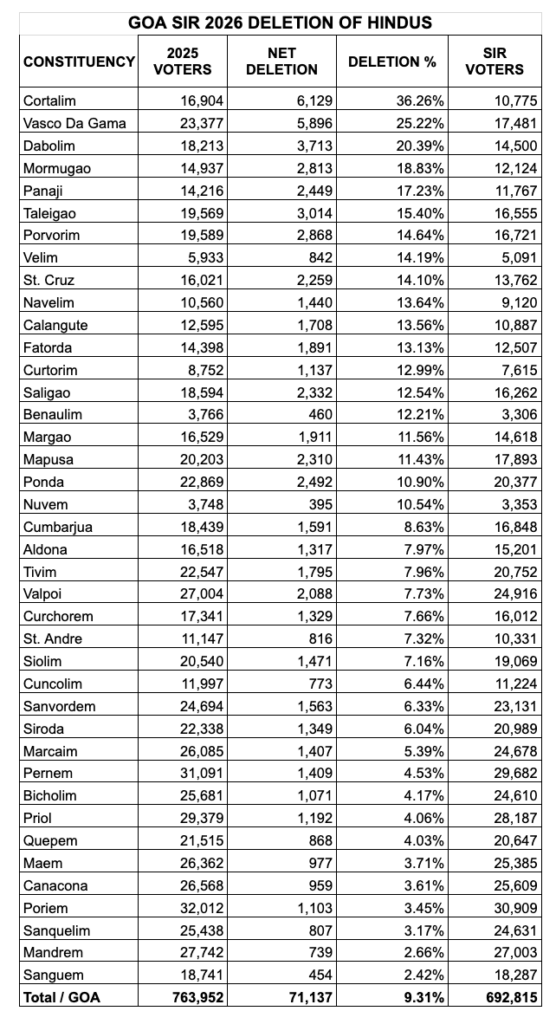
Though state-level deletions of Hindu voters average nine per cent, they are higher in almost 19 constituencies. The remaining 21 constituencies are below the nine per cent average.
The top five are Cortalim, Vasco, Dabolim, Mormugao and Panaji, with deletions between 17% and 36%. The lowest five, between 2% and 4%, are Canacona, Poriem, Sanquelim, Mandrem and Sanguem.
CHRISTIAN DELETIONS
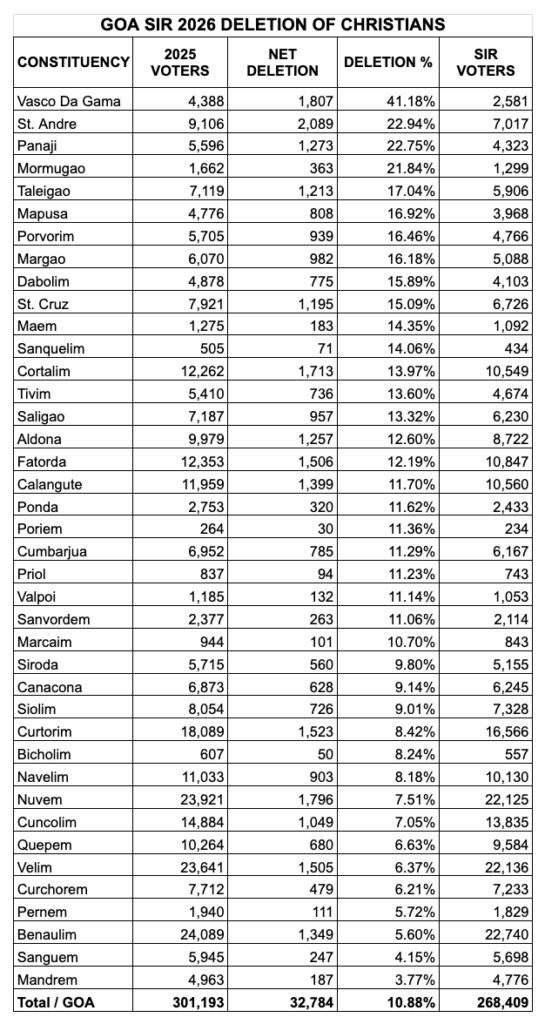
The average deletion of Christian names is 11 per cent at the state level. But 19 constituencies are above average, and the remaining 21 are below average.
The top five among them are Vasco, St. Andre, Panaji, Mormugao and Taleigao. Vasco has the highest deletion percentage at 41%. The remaining four are between 17% and 23%.
The lowest five are Curchorem, Pernem, Benaulim, Sanguem, and Mandrem, with four to six per cent deletions of Christian voters.
MUSLIM DELETIONS
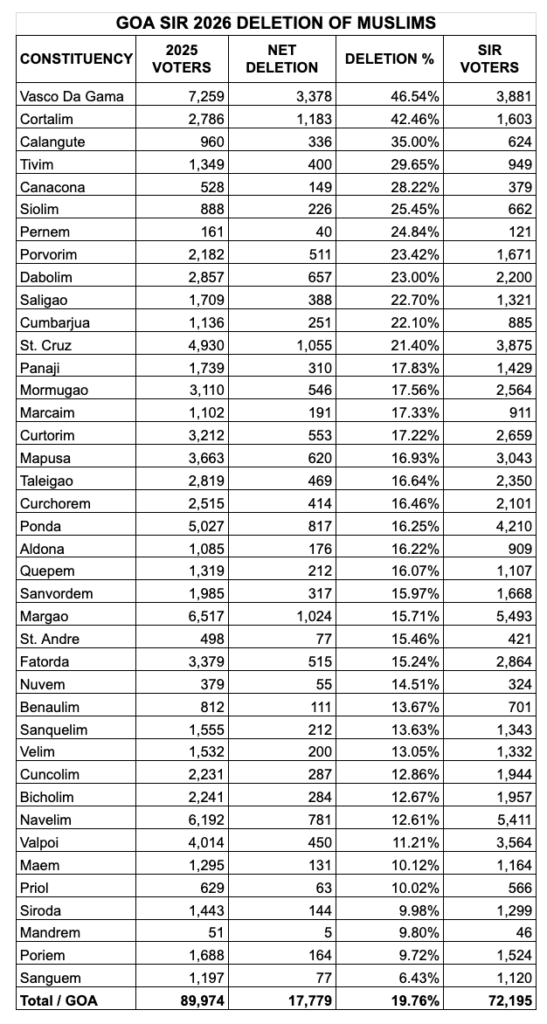
Against 20 per cent deletions among Muslims, 12 constituencies have above-average deletions, ranging from 21% to 47%. The remaining 28 constituencies have deletion rates between six per cent and 18 per cent.
In Vasco, however, nearly half of the Muslim voters (47%) have been deleted. Also, 43% in Cortalim. Besides these, among the top five are Calangute, Tivim and Canacona, ranging between 28% and 35%.
The lowest five Muslim deletions are Priol, Shiroda, Mandrem, Poriem and Sanguem, ranging from six to ten per cent.
METHODOLOGY
The Election Commission of India does not record voters’ religion. The community is thus identified through the voter’s name, father/husband’s name and surname. The software used for this read all voters’ names mentioned in the official records made available on the ECI website through 1,731 booth-wise PDFs of the SIR final roll, as well as the booth-wise ASDD (Absent, Shifted, Dead and Duplicate) lists. They were matched against a list of about 1,200 Goan and Indian name and surname patterns. Where the names pointed to more than one community, or to none, the voter was counted as “Unknown”. That group is 2.2 per cent of all names. Surnames such as Naik, Gaonkar, etc., which are used by Hindus, Christians and also Muslims in Goa, are a known source of error. Where a name points equally to two communities, the voter is counted as “Unknown”.
The headcounts themselves are not estimates. Across all 40 constituencies, the totals read from the PDFs for electors as on 27 October 2025, the draft roll, deletions, additions and the final roll of 21 February 2026 match the Chief Electoral Officer’s own published table in 277 of 280 cells. The three differences are in Mormugao, where the CEO’s published ASDD lists have 315 fewer names than its table.
CLICK TO JOIN GONEWS.COM WHATSAPP COMMUNITY GROUP TO GET FURTHER UPDATES
OR SCAN THE QR CODE
 Screenshot