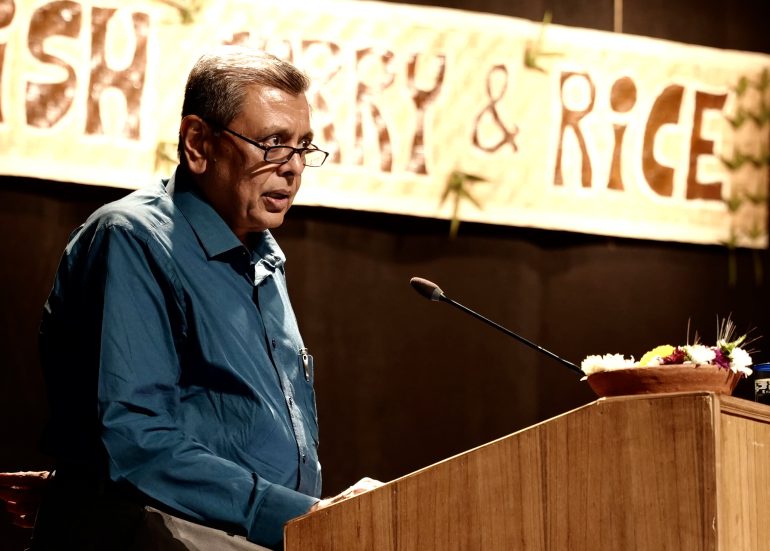
Justice Gautam Patel, renowned former judge of the Bombay High Court, captivated the audience with a thought-provoking lecture at the release of the fifth edition of Dr Claude Alvares’s celebrated book ‘Fish Curry and Rice’ by the Goa Foundation on 14 March 2026.
Echoing his memorable judgment at the Goa bench—“Goa is a land worth fighting for”—Justice Patel’s speech was a masterclass in insight and conviction, making it a must-read (or must-watch).
Why does he passionately advocate for a referendum in Goa, similar to the Supreme Court’s landmark directive in the Odisha Mining case of the Niyamgiri hills?
What led him to boldly declare Section 39A of the Goa Town and Country Planning Act ‘fundamentally unconstitutional’?
How does the retired judge view the keyboard warriors who confine their activism to social media posts rather than participating in the real action?
What connection does he draw between Justice Rebello’s ‘Enough is Enough’ movement and the inspiring triumph of the Chimbel tribals?
Click to watch the full speech of Justice Gautam Patel
Read his full speech:
Good afternoon. It is a privilege not just to be here, but to come back. For me, every trip to Goa, however short, is now like a homecoming. But this evening is especially a privilege because I can now freely associate with those I hold in such high regard: Chief Justice Rebello, a friend of many years and an esteemed senior colleague, Dean D’Cruz—I had the privilege many years ago of staying at one of his early designed boutique hotels, Pousada Tauma—and Norma and Claude Alvares of the Goa Foundation, for whom I have long had nothing but the most profound respect. Each of them for their fidelity to the law and the Constitution, their unimpeachable integrity, their indomitability, and their deep and abiding love for this land.
I need to go back a bit to explain my response to the last of these. For the first time in my life, I was here in 2017 as part of my work as a judge of the Bombay High Court. Until then, I had only visited Goa off and on in what I now believe is the typically blind tourist fashion: a holiday by the sea with a pool, local eateries and so forth. In June 2017, I was here to stay, at least for a short while. I was to work and live here.
The first 24 hours upended everything I thought I knew about this state. I came here with my wife, my sister and her two boys, and we went off to Miramar. Only to be greeted by the phenomenal ugliness of a vessel stranded on the sands. And not just any vessel. A floating casino, the Lucky Seven.
To this day, I cannot explain why I felt the way I did that evening. It was like suffering relentless hammer blows: outrage, despondency, a sense of loss and foreboding, incredible, devastating sadness. And right then, my nephews, then both very young, turned to me and said just this: please do something. My sister added, you must, as if to say, what good are you if you can’t or won’t
Some of you may remember what followed. My great good fortune, and the equally bad luck—this was a casino, remember—of the vessel owners that the case was listed the very next working day. It was low on the list. Someone tried to mention it at the start of the day to adjourn it. I refused. This had to be done, because the words of those two boys were still ringing in my head. I remember saying to my colleague on the bench, Justice Nutan Sardessai, what good are we if we allow this on our watch?
I think we caught them unawares. Especially when we said that before the monsoon went, Lucky Seven had to go; and our beaches first, casinos later. Lucky Seven went. Before the monsoon ended.
And that was just the beginning of what I am now making bold to say is an ongoing love affair with this incredible state. It wasn’t the usual tropes of beaches and a slower pace of life. In many ways, up close and personal, with the freedom to be there for long stretches of time, I was able to wander inland, meet people, visit places. This was a Goa far beyond my experience until then. And yes, I became an incorrigible wanderer. Justice Mahesh Sonak told me I had to see Divar. So off I went one evening, thinking the rain had lessened a bit, and in the spirit of adventure—I was just going across to an island in a river, after all, what could possibly go wrong?—I let my driver go and drove myself. I went up to the chapel, walked about the hill, took in the vista, wandered down past the old houses and then headed for what I thought was the ferry back. But I forgot this was an island, and there was more than one ferry. I took the wrong one, the one to the north. By now there was a torrential downpour. I had no idea where I was. I drove slowly in one direction, totally clueless, and it wasn’t until the next day that I realised I had traversed toward the east, emerging finally at Aldona and Moira before turning west and then south again. My driver was most suspicious when he saw the odometer the next day.

The fifth edition of ‘Fish Curry & Rice’ released at the hands of Justice Ferdino Rebello, along with Justice Gautam Patel, Dr Claude Alvares, Sinatra Fernandes and Dean D’Cruz.
Our work in court was exhilarating—the quality of advocacy, the high quality of pleadings, the range of issues, and to be sure there were moments of shared good humour—a complaint about the size of a Candolim landlady’s pet dukors, for example. And there was this terrific moment with Norma, which I cannot resist recounting. I don’t know how many of you have seen Norma and Claude in action in court. It is something to behold. There’s Norma, compact, almost bird-like, of steely resolve and yet tempering her submissions with one eye firmly to the law. And there’s Claude, sitting well back, watching closely. Nothing much escapes him. Anyway, Norma’s petition was, as I recollect, about—hold on—prawns. There were bunds. And there were people drying prawns on the bunds. Causing, Norma said, massive air pollution. Now this just happened to be called out as it was approaching lunch. And I was getting hungry. I said to Norma, Ms Alvares, we have a problem here, one that is far more significant than you can imagine. Non-plussed, she asked, what might that be sir? I could not resist. If you stop all this drying of shrimp, Ms Alvares, I said, how on earth will I get my daily fix of kismur?
She burst out laughing and next to her Mr Lotlikar remarked loudly, “He’s become a Goan now!”
Cases of different hues came our way in court: that Goa Foundation NGT case you know about, and about which
I want to tell you something in just a moment; that uplifting episode of the young disadvantaged student at GMC, Poonam Zore, whom I would dearly love to meet one day to pay my respects for what she and her family endured and what she achieved; the case about the denial of medical reimbursement to an employee of a local government social welfare body; and many others. And at the same time, I was learning about the quiet contribution of Goa to almost everything, from staple foods to music across genres, a variety of art forms, and more.
Like the rain, Goa had seeped into my heart. You do not need alcohol in Goa to be intoxicated.
But over several weeks, I was beset by a sense of immense disquiet. Something was going very wrong here. It almost seemed that there was a yawning chasm between the underlying grace and beauty and gentleness and the steady piling on of one unspeakable thing after the other.
And then came that NGT Goa Foundation case, which we took up as a suo motu PIL even as Goa Foundation filed its own. We heard it and decided it, and you all know the passage in that judgment.
It almost didn’t happen.
I had the draft ready, and I felt something elemental was missing. So I went back late one night and wrote it. And the next morning, I showed it to one of my judicial interns, a young man now in practice here. “It has no business being here in a judgment,” I told him. “It’s totally obiter, more than somewhat over the top, a useless ex cathedra piece of prose.” The young man read it twice, slowly the second time, and said in a very quiet voice, “Sir, I think you need to leave it in.
Despite everything you just said.” And later, I showed it to a senior advocate, long retired, who had called on me. He read it silently, slowly, and in voice filled with emotion said but you are an outsider, and yet…
That, my friends, is exactly Goa’s problem today. What we are witnessing here is a process of what we know as ‘othering’, where Goans have become the others, the lesser, the immaterial ones, the ones who do not matter; and those who are not Goans, who make no attempt at all to know or understand Goa are the ones who take all the decisions about the land, the people, the culture. And this is being done not just by outsiders but is being actively facilitated from those within, by those from Goa.
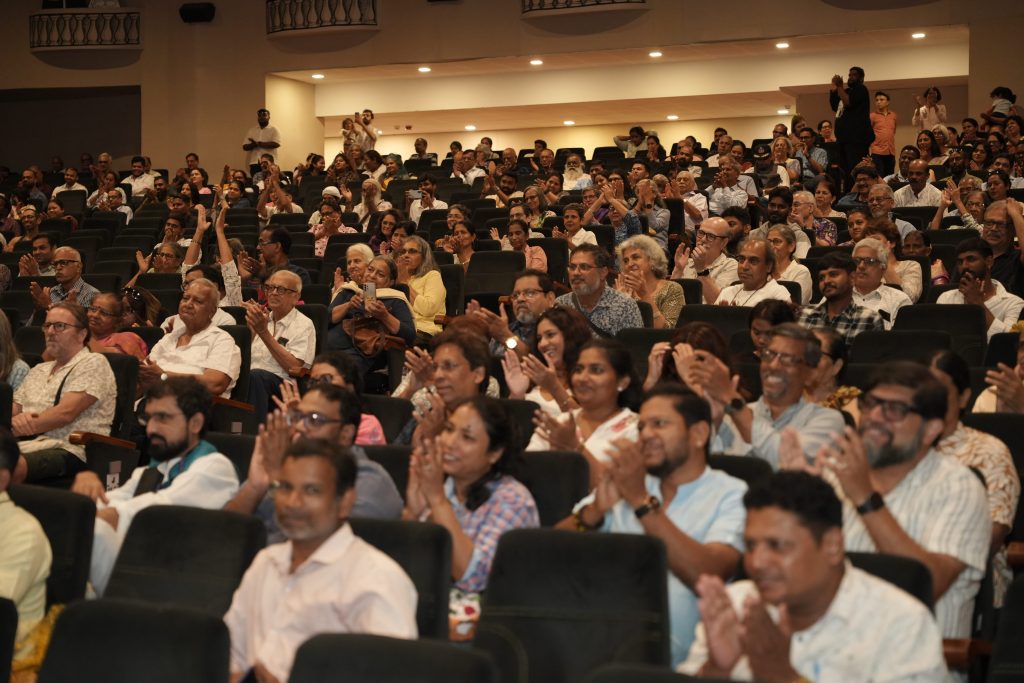
The audience at the Goa Foundation function at Kala Academy
This is no simple binary. There are many from Goa who continue to soldier on in their own way, some with advocacy, some in their writing—my good friend Vivek Menezes being a case in point, solidly keeping the flame alive. But there are others who are not originally from Goa who have come here and, in an essential, irreversible way, have become Goan. I am not talking about the many stalwarts who have roots here. This very building, the Kala Academy, and its origins with Charles Correa—we know the struggles of the foundation that bears its name to preserve this, and we know that the assault on it came from within. But I know very many whose concern is greater than mine, but who are not originally from here. The difference is that they have made Goa their home. They have meshed with the community, the people, the land. Karanjeet Kaur is from Delhi but writes steadily about the problems here. Vikram Patel and Gauri Divan had the world to choose from, and they chose Goa. Sanjeev and Sonali Trivedi leave family in Mumbai and begin work in Goa and restore an old house.
As I left Goa, the bar hosted a farewell dinner. I think my colleagues were a little shell-shocked by the sheer vivacity of the evening, but it was typically Goan (including freely making fun of me), all in good spirits. That evening, in a quiet corner, the then Advocate General asked if I would ever get a house here. “No,” I said to him, “not unless I could make a home here.” That is a distinction that those who impose their will seem to have forgotten. This land is not a piece of meat in a butcher shop to be carved up and distributed. It is a home, and it needs to be treated like one.
How have we come to this pass in Goa?
Let me put this in some context. And let us understand one fundamental problem: the stereotyping of Goa. For those not from here, from Mumbai, Delhi and Ahmedabad especially, who buy up tracts of land and construct monstrous houses with not even a nod to Goan architecture, heritage, culture, climate, environment, or ecology, all done in pretty much the same style, one we might call Dubai chic, or perhaps more accurately post-aesthetic architecture, Goa is just one thing. It is a backdrop. It might as well be CGI, scenery painted on a screen and laid behind the trophy dwelling.
In a word, Goa is made irrelevant. And in popular imagination, too, there are nothing but stereotypes, the rubbish portrayal of a ‘typical’ Goan in Hindi movies, one devoted only to drink and Church in equal measure or, sometimes, the cassocked Catholic priest. There’s nothing in between. This imagery has sunk deep roots. One evening, my dear friend the late Maria Aurora Couto recounted the horrifying story of what her husband, the highly regarded civil servant, Alban, was asked by a vice-admiral of the Indian navy as his fleet approached these waters: to ‘provide’ for those aboard shortly to come ashore.
And lest we pretend this did not take root, recall that infamous comment by the leading light of a now defunct journal, supposed in its origin to be a beacon of light and truth, at one of its early festivals here. “Now you are in Goa, and you can drink as much as you like, and sleep with whomever you want.”
There was outrage, and rightly so; but what came of it? What is this? The horrifying, typical, stereotyped!
Exactly the same thing is happening again. It is only the form that is different. Goa is still seen as a mere backdrop, a stereotype, and therefore it is apparently perfectly all right, to dismantle Goa bit by bit.
I am here to say that though I am not from Goa, and for reasons I myself will probably never fully understand, it is not all right.
It is most emphatically not all right.
The sheer number of environmental issues affecting Goa, and not in a good way, is staggering. Forests, wildlife corridors, coastal and marine and estuarine areas, lakes and waterbodies, the list is endless. Fling a dart, and you will hit an ecological or environmental disaster, whether it is Mopa, Chimbel, Miramar, Reis Magos or Mollem. This is precisely for the one reason that those elected to power just do not seem to understand. Goa’s ecology is especially fragile, and the smallest intervention here has an outsized effect. That may partly be because the state itself is so small, but it is also because of the quality and richness of the ecology. This is why Goa has been the frontrunner in significant
environmental litigations over the years.
But let me enter a caveat here. I spoke earlier about the high quality of litigation in Goa. This is the first of at least three issues. Courts cannot make policy. Rushing to courts each time, and especially with ill-considered and poorly researched petitions, is always a mistake; and a costly one because sometimes to have a petition on a worthy cause dismissed is worse than not filing it at all. It clears the road for the opponents. Second, all too often in Goa, there is an unacceptable muddling of what constitutes a genuine public interest litigat ion and what is a purely private dispute. Agitating in court about a neighbour’s mango trees and dressing this up as a PIL is just nonsensical, and a colossal waste of time and energy.


But there’s a third factor at play here, the unthinking use of which I want to decry in the strongest possible terms. It is the dark side of the social media and the internet. These may be good starting points for further investigation, debate and so forth. But today, these have become not just crutches but feel-good escapes from the brutal, hard work of confronting problems, in the way the G oa Foundation does. Just posting a comment on X or Instagram or Facebook is emphatically not a substitute for actual engagement with advocacy groups. The fact that you have chosen to come here in person today in such large numbers tells me all is not yet lost; but the danger exists and it is my duty to caution you against complacency. Don’t sign online petitions. Don’t put things on X or Facebook or Instagram and think the job is done. It isn’t. The job is on streets, the job is on Azad Maidan, the job is 24 days!

Justice Gautam Patel along with other dignitaries and Warriars of Chimbel, Goa
I am the last one to advocate or commend a revolution or a revolt of any sort. But I do expect that every citizen must know her and his rights and must be prepared to defend these loudly and together. Courts are, and always should be, the last resort, not the first.
Which brings me to the 800-pound gorilla in the room, the infamous Section 39A of the Town & Country Planning Act, introduced by amendment in 2024. As I understand it, this clever little piece of legislative sleight of hand allows the Chief Town Planner to almost whimsically change land-use zoning. True, there is a provision of a one-month period for suggestions and objections but as we all know this is simply cosmetic. The decision is already made.
There is a far more fundamental issue here. When we talk about town planning, a basic construct, what lawyers call the sine qua non—the essential—is public participation in the planning process. This phrase is not explained and is often distorted. Is allowing for ‘suggestions and objections’ sufficient public participation? Or should a community be entitled to decide for itself—not have something imposed top-down—what it does and does not want?
A unique aspect of Goa’s land use is this sense of community over land and land-based resources. I do not need to explain that more fully here, and I dare say each of you understands it more thoroughly than I do.
What Section 39A has done is to simply obliterate this community-driven decision-making and replace it with the God-like wisdom—or supposedly god-like wisdom—of the Chief Town Planner.
If this sounds familiar, it should. Once again, we see the by-now familiar tropes of reducing Goa and its people to irrelevance, the land to a backdrop, and, in full cry, what I call the infantilisation of an entire populace: what are you being told? That you, each one of you, each one of us, is too infantile, too mutton-headed, just too stupid to
understand what is best for us. The Chief Town Planner, the God, will decide. We will then go to him as a supplicant, and you will say ‘I Object’. And he will wave away your objections, and there goes your land, there goes your rights. There will be cacophony. And nothing will change.
This is not how it should be, and I will tell you now that there is the strongest possible judicial principle in support of the right to environmental self-determination that I advocate today. It comes from the Supreme Court, in the 18 April 2013 Supreme Court judgment by Justice Radhakrishnan in the Orissa Mining case about mining in the Niyamgiri hills in Odisha. The parallels with us today are uncanny. Governments, project proponents and even previous Supreme Court benches held that because the local people were so poor, they could not know what was good for them; and therefore, the so-called development proposed was a jolly good thing. I wrote an essay recently for a volume edited by Justice Muralidhar, titled Incomplete Justice on 75 Years of the Supreme Court. My essay was titled “Consistently Inconsistent” and was about the Supreme Court’s track record on environmental protection. The Supreme Court expressly rejected the top-down approach and firmly advocated the right to environmental self-determination—going so far as to order a referendum.
Let us test this. Let there be a referendum on any of the land-use zoning changes proposed by the Chief Town Planner, not just suggestions and objections. And let the Chief Town Planner behave as he should, as a public servant with the emphasis decidedly on servant and not as some self-inflated satrap exercising dominion over that which is not his but is yours and your community’s. I dare say the Plan will be lost and will be voted out. If you want public participation, then suggestions and objections and hollow formalities are not the answer. Let the community vote on it and let us see what happens. And this is the reason I am saying that 39A is fundamentally unconstitutional. Let me quote from a recent article by Vivek Menezes about this. He spoke to Dr Goes of Columbia University. Here is what Vivek in turn quoted:
He says, “Two back-to-back victories in Chimbel and St André remind us of something powerful: there is strength in unity. When people stand together, power is forced to listen. The attempts to bully, intimidate, and the pressure all of it collapsed in the face of united communities. But two victories do not end the fight. The larger struggle must continue, to free entire Goa from the 39A curse, to reclaim our rivers from casinos, but most importantly to rid our state of arrogance and corruption in public office.”
The first thing I saw this afternoon, as I got off the flight, was an advertisement for a casino. And on the way here, I was told by young advocate much more: a high-end restaurant within spitting distance of the nesting sites of Ridley turtles, a seven-star deluxe hotel being allowed to ram through sand dunes to accommodate a five-star hotel chain…when will it end? The answer you will find in what Justice Rebello says: Enough is Enough!
You are under pressure. I understand that. Resisting this kind of pressure is difficult. Especially by individuals. And this is how these planners and developers succeed. By balkanising your communities, dividing you, the people, taking away your land and your right of self-determination, your right to decide what should and should not be allowed to happen to your community land and criminalising protest.
There’s a word for this pattern, one that runs throughout recorded human history. It’s called conquest!
Late one evening, I sat with Maria Aurora Couto on the verandah of her gracious home in Aldona. The day was
sinking. There was a primordial quiet here, just the soft hiss of a gentle rain on the leaves. She, the grand old lady of Goa, was ailing now but of undiminished spirit. But you could see the ache in her eyes and hear the sadness in her voice. It was to be the last time we met.
“How often?” she asked in so low a voice it seemed almost she was speaking to herself. Or possibly to her god. “How often will we Goans be conquered like this?”
Thank you for listening.
I want to say something to the people from Chimbel. सॉरी, मी कोंकणीत बोलू शकत नाही, पण मराठीत बोलेन. 44 दिवस तुम्ही उपोषण केलंत. ती बातमी फक्त गोव्यात नव्हे, मुंबईपर्यंत पोचली. तुमचे एकेकाचे आवाज तिथपर्यंत ऐकू आले. तुम्ही कशासाठी लढत होतात ते आम्हाला कळलं. हा फक्त विजय नव्हे, परंतु एका महत्वपूर्ण गोष्टीची ही सुरवात आहे. संपूर्ण गोव्यामध्ये याचा प्रसार झाला पाहिजे, आणि हे पसरलं पाहिजे. हे सगळं सुधारेल. आणि ही शक्ती फक्त तुमच्या हातात आहे. हे तुम्ही करून दाखवलयं. ही आमची जमीन, हे आमचे हक्क, हे आमचे आवाज तुम्हाला ऐकावेच लागतील. ऐकले नाहीत, तर खबरदार!