
Goa SIR Decoded - Part II
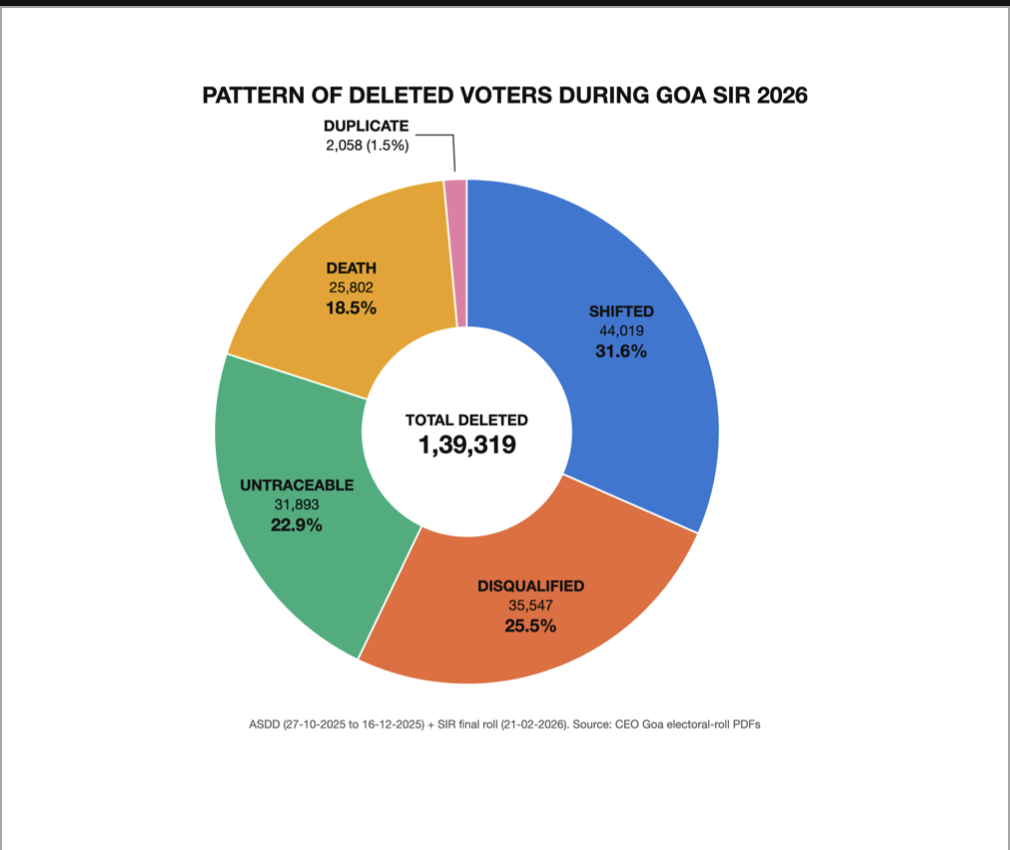
The Election Commission of India deleted almost 80 per cent of voters during the Special Intensive Revision (SIR) because they had shifted, were untraceable, or had been disqualified. This number is around 1.11 lakh, out of 1.39 lakh total deletions.
Names of hardly 20 per cent – around 28,000 voters – have been deleted because they are dead or have registered as voters in more than one place, meaning they are duplicates. The SIR could identify only 25,802 (19%) voters as dead, and only 2,058 (1.5%) duplicate names.
The total number of shifted voters is 44,019 (32%), untraceable voters are 31,893 (23%), and disqualified voters are 35,547 (25%).
The general impression is that many Goans have shifted abroad, either with Portuguese passports or US citizenship etc, but their names remained on the electoral roll. But the Goa CEO has already clarified that only 419 foreign nationals have been deleted during the SIR.
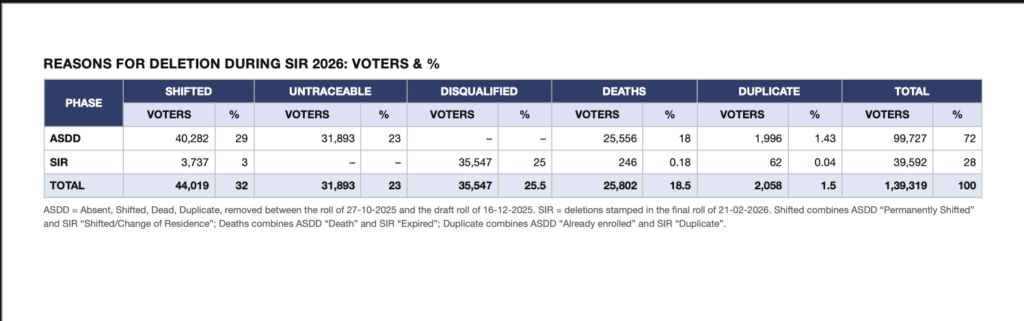
The SIR exercise took place in two main phases. The first one was called ASDD, meaning Absent, Shifted, Dead and Duplicate. For this, the electoral roll of 27/10/2025 served as the base. After subtracting the ASDD figures, the ECI prepared a draft roll on 16/12/2025 and conducted the final SIR.
The ECI did not further verify the names deleted in the ASDD exercise.
The ASDD exercise considered four criteria: absent (untraceable), permanently shifted, death, and duplicate (already enrolled). Interestingly, a major chunk of voters was deleted at this initial stage in Goa. It was nearly one lakh (99,727) voters, out of a total of 1.39 lakh deletions, meaning 72 per cent, nearly three-fourths.
In the ASDD, around 40,000 (29%) were deleted because they had permanently shifted; around 32,000 (23%) were absent or untraceable; around 26,000 (18%) were deaths; and only one per cent were duplicates (1996).
In the second phase of SIR, around 40,000 (28%) more voters were deleted. A major chunk of this was due to a disqualification criterion, accounting for around 36,000 (25%). The shifting category accounted for only three per cent (3737); 246 more deaths were reported (0.18%) and 62 duplicates (0.04%).
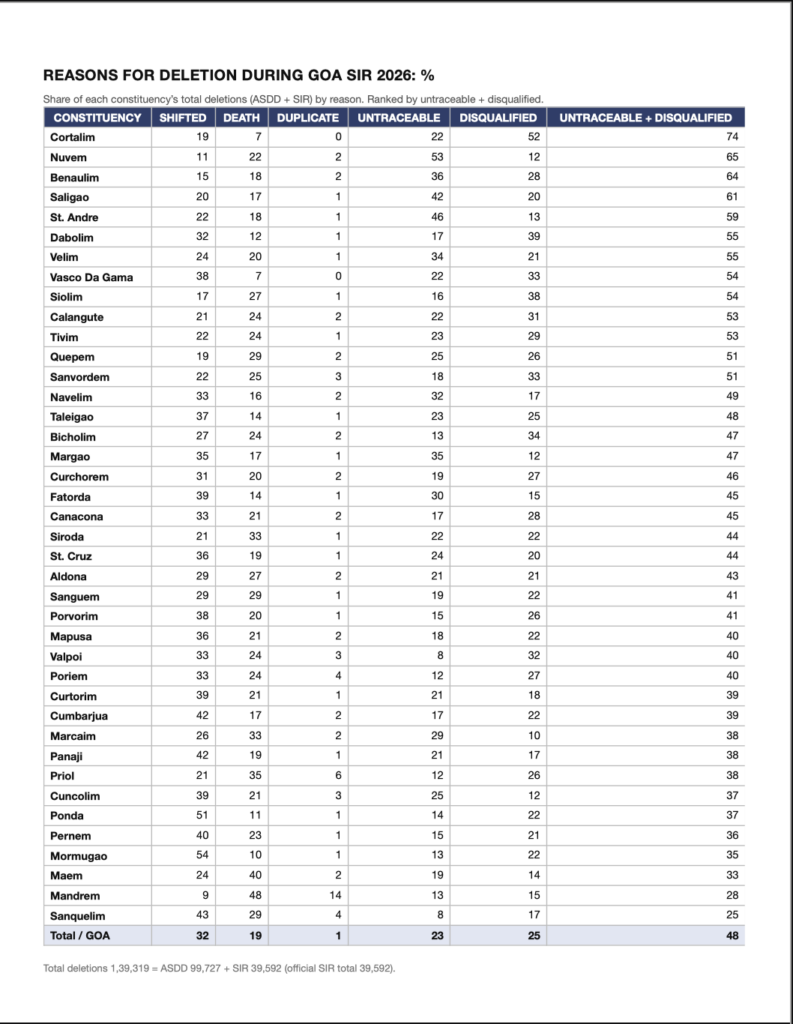
Combined, untraceable and disqualified voters make up nearly half of all deleted voters: 48 per cent, or over 67,000 voters.
UNTRACEABLE + DISQUALIFIED: 61% TO 74%
The constituency-wise breakdown is much more alarming. Together, untraceable and disqualified voters reach nearly 75%, or three-fourths. Four constituencies in the Old Conquests fall in the 61-74% range.
MORMUGAO: Cortalim (74%)
SALCETE: Nuvem (65%), Benaulim (64%)
BARDEZ: Saligao (61%)
UNTRACEABLE + DISQUALIFIED: 51% TO 59%
Although the average percentage of untraceable and disqualified voters is slightly below 50% at the state level, it exceeds the half-mark in nine more constituencies. Seven among them are from the Old Conquests, and two are from the New Conquests.
TISWADI: St Andre (59%)
MORMUGAO: Dabolim (55%), Vasco (54%)
SALCETE: Velim (55%)
BARDEZ: Siolim (54%), Calangute (53%), Tivim (53%)
QUEPEM: Quepem (51%)
DHARBANDORA: Sanvordem (51%)
THE LOWEST FIVE
In 15 constituencies, around 40 to 49 per cent of the deleted voters are either untraceable or disqualified. The remaining 12 constituencies reported deletions for the same reason, ranging from 25 to 39 per cent. The lowest five among them are:
PERNEM: Pernem (36%), Mandrem (28%)
MORMUGAO: Mormugao (35%)
BICHOLIM: Maem (33%), Sanquelim (25%)


ABOVE AVERAGE ‘SHIFTED’ IN 19 CONSTITUENCIES
As per the ECI guidelines, temporary absence due to work, education, or travel does not qualify an elector as “Shifted.” It must be a permanent change of residence. The voter has to permanently cease to reside “ordinarily” at the address registered in the current electoral roll.
Under Section 20 of the Representation of the People Act, 1950, a person must be an “ordinary resident” of a constituency to be registered there. If an individual has permanently moved his/her household out of the polling area (either to another part of the constituency or to a different constituency altogether), the voter loses his/her right to be on that specific roll and must be categorised as “Shifted”.
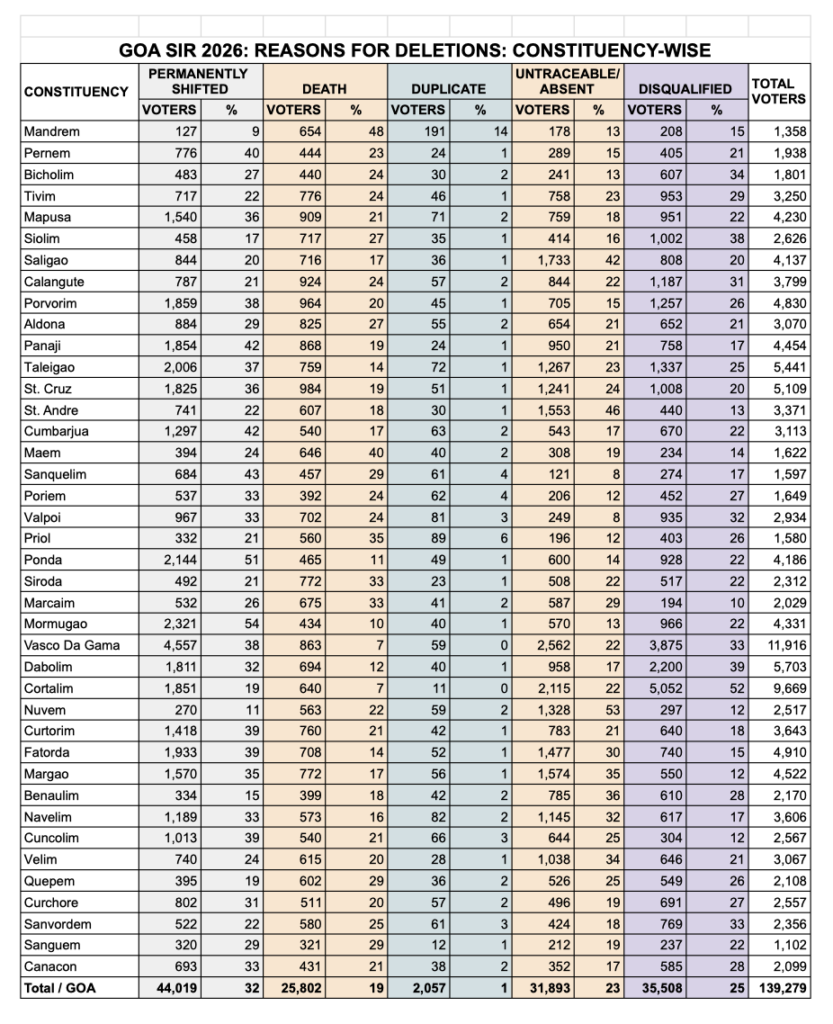
During Goa’s SIR exercise, in two phases, over 44,000 voters have been categorised as ‘shifted’. This is the highest category overall, with 32 per cent deletions. In some constituencies, this rate is quite high, such as Mormugao (54%), Ponda (51%), Sanquelim (43%), Cumbarjua and Panaji (42%), and Pernem (40%).
Above the state average of 32 per cent, deletions due to shifting are in 13 constituencies. These are Cuncolim, Fatorda, Curtorim, Porvorim, Vasco, Taleigao, Mapusa, St Cruz, Margao, Canacona, Navelim, Valpoi and Poriem.
(Refer to the table to find all the constituencies)
WHO ARE ABSENT OR UNTRACEABLE?
As per the ECI, persons are classified as ‘absent’ or ‘untraceable’ if the Booth Level Officer (BLO) cannot find or verify them physically at their registered house, or if their immediate whereabouts are unknown to neighbours or ‘local authorities’.
In Goa, around 32,000 voters (23%) could not be traced by the BLOs and were declared as ‘untraceable’. This exercise was conducted during the first phase of the ASDD, a one-and-a-half-month exercise between November and the first half of December 2025.
Although the average rate of untraceable voters is 23 per cent, it reaches up to 53 per cent (Nuvem) in almost 12 constituencies. These are St. Andre, Saligao, Benaulim, Margao, Velim, Navelim, Fatorda, Marcaim, Cuncolim, Quepem and St. Cruz.
WHO GETS ‘DISQUALIFIED’?
Normally, a voter is disqualified if he or she incurs any constitutional or statutory disqualifications specified for registration in an electoral roll. According to Section 16 of the Representation of the People Act, 1950, a person is disqualified from being registered in the electoral roll if they:
- Are not a citizen of India (loss of citizenship or acquiring foreign citizenship).
- Are declared by a competent court to be of unsound mind.
- Are for the time being disqualified from voting under the provisions of any law relating to corrupt practices and other offences in connection with elections.
Before disqualifying any voter, the Election Commission serves notice and holds a hearing. But even after the hearing, if the person cannot find their parents’ or grandparents’ names in the 2002 electoral roll (the last SIR), the voter must undergo a stringent verification process to establish residency in that area. This normally applies to those who have moved into the constituency in the last 24 years.
In Goa, around 36,000 voters were disqualified during the SIR. That too, when the foreign nationals were found to be only 419 persons. They are one-fourth (25%) of the total deleted voters.
The major chunk of 72 per cent of deletions took place during the first ASDD phase, when nearly one lakh voters were deleted. It contained around 40,000 shifted voters and 32,000 untraceable voters. A total of 1,731 Booth Level Officers (BLOs) are expected to address these 72,000 voters by repeatedly visiting their houses and ultimately concluding that they were either permanently shifted or untraceable. On average, they had to visit 42 houses when the house was open and people were available. This exercise was carried out in 45 days (1st November to 15th December). Whether the BLOs are so super-competent, or whether some other modus operandi was used, is a mystery!
Read Part I